<?xml version="1.0" encoding="utf-8"?><feed xmlns="http://www.w3.org/2005/Atom" ><generator uri="https://jekyllrb.com/" version="3.10.0">Jekyll</generator><link href="https://daniellopezmartinez.com/feed.xml" rel="self" type="application/atom+xml" /><link href="https://daniellopezmartinez.com/" rel="alternate" type="text/html" /><updated>2026-06-09T13:40:02+00:00</updated><id>https://daniellopezmartinez.com/feed.xml</id><title type="html">Daniel Lopez-Martinez</title><subtitle>Daniel Lopez-Martinez is a Senior Applied Scientist at Amazon (ex-Google) with a PhD from Harvard/MIT, working on large language models, agentic AI, computer-use models, and trustworthy AI.</subtitle><author><name>Daniel Lopez-Martinez</name></author><entry><title type="html">The Evaluation Stack for Health AI</title><link href="https://daniellopezmartinez.com/posts/2026/03/2026-03-15-health-ai-evals" rel="alternate" type="text/html" title="The Evaluation Stack for Health AI" /><published>2026-03-15T00:00:00+00:00</published><updated>2026-03-15T00:00:00+00:00</updated><id>https://daniellopezmartinez.com/posts/2026/03/heath-ai-evals</id><content type="html" xml:base="https://daniellopezmartinez.com/posts/2026/03/2026-03-15-health-ai-evals"><![CDATA[<p>For a long time, medical AI evaluation was dominated by knowledge benchmarks: medical licensing exams, multiple-choice question answering, and short clinical vignettes <a href="#ref-1">[1]</a>. These benchmarks were useful. They helped establish that language models had absorbed enough medical knowledge to be taken seriously at all.</p>

<p>But health AI is no longer just about answering exam-style questions or generating plausible-sounding advice. The frontier is shifting toward systems that hold real-world conversations with patients, ask follow-up questions, retrieve context, explain medical information, and increasingly take action inside clinical workflows. Once that happens, the old defaults for evaluation start to break down.</p>

<p>A model can do very well on a licensing-style benchmark and still be weak at triage. It can look strong on a static vignette and still fail once a real user is involved. It can sound clinically sophisticated and still make mistakes when it has to gather missing information, manage uncertainty, or execute a workflow correctly.</p>

<p>Frontier models now perform extremely well on many medical knowledge benchmarks. But as health AI moves toward broader real-world deployment, we are learning a more humbling lesson: saturating a knowledge benchmark is not the same as practicing medicine safely.</p>

<p>That is why health AI needs an evaluation stack.</p>

<h2 id="the-knowledge-benchmark-era">The Knowledge Benchmark Era</h2>

<p>Until recently, health AI evaluation focused heavily on medical licensing exams and multiple-choice question answering [<a href="#ref-1">1</a>, <a href="#ref-3">2</a>], as well as short clinical vignettes <a href="#ref-4">[4]</a>. These benchmarks served a real purpose. They were standardized, reproducible, and gave the field a shared language for measuring progress. And the progress was real: language models performing strongly on medical knowledge benchmarks was a legitimate scientific achievement.</p>

<p>However, these benchmarks are not the endpont.</p>

<p>Saturating a knowledge benchmark doesn’t tell you whether a system is safe or useful when deployed.  For example, A model that can ace a multiple-choice question about beta-blocker pharmacology may still fail in practice when a patient reports dizziness on bisoprolol without volunteering their fever severity, and the system recommends a routine next-day appointment instead of urgent evaluation. While the knowledge may be there, the clinical judgment, exercised dynamically across a real conversation with incomplete information, may not necessarily be.</p>

<p>So knowledge benchmarks that answer the question: <em>does this model know medicine?</em> is a necessary condition, but it is nowhere near sufficient.</p>

<h2 id="the-interaction-gap">The Interaction Gap</h2>

<p>The deeper problem is structural. Most traditional benchmarks are single-turn: the system receives a fixed input and produces a fixed output. Real health interactions are nothing like that. A patient begins with partial information, answers follow-up questions selectively, and interprets the system’s responses through their own health literacy, emotional state, and prior experiences.</p>

<p>That means model capability does not automatically translate into effective real-world use.</p>

<p>Recent work has made this gap especially clear. When leading models are tested in isolation on fully specified medical scenarios, they may perform impressively. But once real users are involved, performance can deteriorate sharply <a href="#ref-2">[2]</a>. Users may omit important details, describe symptoms imprecisely, or misunderstand the system’s guidance. A strong model can still underperform in practice if the interaction itself is poorly scaffolded.</p>

<p>This is why health AI evaluation is partly a modeling problem, but also an HCI problem. The relevant question is not only whether the model can produce a high-quality answer. It is also whether the system helps the user arrive at the information needed for a safe answer in the first place.</p>

<h2 id="the-agentic-dimension">The Agentic Dimension</h2>

<p>The problem becomes even harder once health AI systems stop being pure question-answering systems and start becoming agents. A traditional benchmark can tell you whether a model knows something, or even whether it can produce a reasonable answer under controlled conditions. But agentic health AI has to do more than answer. It has to decide what information is missing, determine whether it is safe to proceed, use tools correctly, and complete workflows without creating new risks in the process.</p>

<p>That changes the evaluation target. The question is no longer just whether the model produced a good response. It is whether the system behaved appropriately as an actor inside a clinical workflow. And that requires measuring dimensions that traditional benchmarks do not capture.</p>

<h2 id="the-right-unit-of-evaluation-is-the-system">The right unit of evaluation is the system</h2>

<p>For health AI, the right unit of evaluation is almost never just the base model. It is the <strong>system</strong>: the model, prompts, retrieval layer, policy constraints, tools, escalation logic, interface, and the human on the other side of the interaction. That distinction matters because failures often happen in the seams.</p>

<p>The frame I find most useful is to think about evaluation as a stack rather than a single test. For me, that stack has five layers.</p>

<ol>
  <li>Capability evaluation: Can the model retrieve relevant medical knowledge, reason over symptoms, recognize obvious red flags, and follow core safety policies?</li>
  <li>Conversation evaluation: Can it handle realistic, multi-turn interactions with appropriate context gathering, uncertainty expression, escalation behavior, and communication quality?</li>
  <li>Workflow and agent evaluation: Can it use tools correctly, maintain state, avoid hallucinating completed actions, and behave reliably inside healthcare workflows such as triage, refill management, scheduling, or information retrieval?</li>
  <li>Human-AI evaluation: Do patients or clinicians actually use the system well? Do they know what information to provide? Do they interpret outputs appropriately? Does the interface support good judgment?</li>
  <li>Prospective real-world evaluation and post-deployment monitoring: Does the system work under real conditions, with real users, real oversight, and ongoing surveillance for regressions, failure modes, and unexpected patterns of use?</li>
</ol>

<p>Each layer answers a different question. None of them fully substitutes for the others.</p>

<h2 id="in-conclusion">In Conclusion</h2>

<p>The question of how to evaluate agentic health AI fairly and comprehensively is unsolved. But the conversation is moving in the right direction: toward multi-turn interaction, realistic patient complexity, evaluation frameworks that treat clinical safety as a primary criterion, and the recognition that evaluating agents requires measuring what they do and the corresponding outcomes, not just what they say.</p>

<p>The future of health AI will be built on warranted trust. Warranted trust requires the ability to actually distinguish systems that are safe and effective from systems that merely look impressive under the controlled conditions where we tend to measure them. Getting that distinction right isn’t a technical footnote to the work of building these systems.</p>

<p>It is the work. And the right mantra for the next phase of the field is simple: <strong>evaluate the system, not just the model.</strong></p>

<h2 id="references">References</h2>
<ul>
  <li><a id="ref-1"></a>[1] <a href="https://www.nature.com/articles/s41591-024-03423-7">Toward expert-level medical question answering with large language models</a></li>
  <li><a id="ref-2"></a>[2] <a href="https://www.nature.com/articles/s41591-025-04074-y">Reliability of LLMs as medical assistants for the general public: a randomized preregistered study</a></li>
  <li><a id="ref-3"></a>[3] <a href="https://www.nature.com/articles/s41598-025-31010-4">Benchmarking large language models on the United States medical licensing examination for clinical reasoning and medical licensing scenarios</a></li>
  <li><a id="ref-4"></a>[4] <a href="https://www.nature.com/articles/s41598-023-45223-y">A vignette-based evaluation of ChatGPT’s ability to provide appropriate and equitable medical advice across care contexts</a></li>
</ul>]]></content><author><name>Daniel Lopez-Martinez</name></author><category term="health-ai" /><category term="llms" /><category term="evaluation" /><category term="ai-safety" /><category term="healthcare" /><summary type="html"><![CDATA[Why medical knowledge benchmarks aren’t enough for real-world health assistants, and what an evaluation stack should look like as Health AI moves from static vignettes to conversational, action-taking systems.]]></summary></entry><entry><title type="html">Launching Amazon Health AI for Prime Members</title><link href="https://daniellopezmartinez.com/posts/2026/03/2026-03-10-launching-amazon-health-ai-for-prime-members" rel="alternate" type="text/html" title="Launching Amazon Health AI for Prime Members" /><published>2026-03-10T00:00:00+00:00</published><updated>2026-03-10T00:00:00+00:00</updated><id>https://daniellopezmartinez.com/posts/2026/03/launching-amazon-health-ai-for-prime-members</id><content type="html" xml:base="https://daniellopezmartinez.com/posts/2026/03/2026-03-10-launching-amazon-health-ai-for-prime-members"><![CDATA[<p>Today marks an exciting milestone for our team at Amazon: <a href="https://amazon.com/health-ai">Health AI</a> is now rolling out to millions of Amazon Prime members.</p>

<p>Over the past few months, our team has been heads-down building something we believe can fundamentally change how people manage their health. Health AI is a personal AI-powered health assistant designed to help customers understand their health information, navigate care options, and connect directly with services such as One Medical.</p>

<p>Following an initial launch with One Medical earlier this year, we are now expanding the experience so that it becomes available directly on Amazon.com and in the Amazon App for Prime members.</p>

<p>Building a 0→1 product in healthcare requires deep collaboration across science, engineering, product, clinical, and safety teams. It has been a privilege to work alongside such a talented group of colleagues to bring this vision to life.</p>

<p>This launch represents an important step toward making healthcare more accessible, more understandable, and better integrated into everyday life.</p>

<p>You can read more about the launch here: <a href="https://www.aboutamazon.com/news/retail/amazon-health-ai-agent-one-medical">https://www.aboutamazon.com/news/retail/amazon-health-ai-agent-one-medical</a></p>

<h2 id="media-coverage">Media Coverage</h2>

<p>I’m humbled by the reception so far. Below is a running list of news articles and external coverage about this launch:</p>

<ul>
  <li>Reuters: <a href="https://www.reuters.com/legal/litigation/amazon-launches-healthcare-ai-assistant-its-website-app-2026-03-10/">Amazon launches healthcare AI assistant on its website, app</a></li>
  <li>TechCrunch: <a href="https://techcrunch.com/2026/03/10/amazon-launches-its-healthcare-ai-assistant-on-its-website-and-app/">Amazon launches its healthcare AI assistant on its website and app</a></li>
  <li>TechRepublic: <a href="https://www.techrepublic.com/article/news-amazon-health-ai-app-site/">Amazon Expands Health AI to Its Retail App, Offering Prime Members Free 24/7 Virtual Care</a></li>
  <li>CNET: <a href="https://www.cnet.com/tech/amazon-expands-health-ai-access-for-amazon-users-looking-to-receive-virtual-healthcare/">Amazon Expands Health AI Access for Virtual Health Care</a></li>
  <li>HealthcareDive: <a href="https://www.healthcaredive.com/news/amazon-expands-access-health-ai-assistant-chatbot/814395/">Amazon expands access to health-focused AI assistant</a></li>
  <li>TechTarget: <a href="https://www.techtarget.com/patientengagement/news/366639961/Amazon-expands-Health-AI-chatbot-to-all-Prime-members">Amazon expands Health AI chatbot to all Prime members</a></li>
  <li>Gadget Review: <a href="https://www.gadgetreview.com/amazon-launches-ai-health-assistant-for-everyday-medical-questions">Amazon Launches AI Health Assistant for Everyday Medical Questions</a></li>
  <li>Seeking Alpha: <a href="https://seekingalpha.com/news/4562859-amazon-health-ai-launched-website-and-app">Amazon health AI assistant launched on website and app</a></li>
  <li>Fierce Healthcare: <a href="https://www.fiercehealthcare.com/ai-and-machine-learning/amazon-launches-health-ai-assistant-its-website-expands-free-virtual-care">Amazon launches health AI agent on its website, expands free virtual care to 200M Prime members</a></li>
  <li>PYMNTS: <a href="https://www.pymnts.com/amazon/2026/amazon-scales-health-ai-assistant-to-all-us-customers/">Amazon Scales Health AI Assistant to All US Customers</a></li>
  <li>Entrepreneur: <a href="https://www.entrepreneur.com/business-news/amazon-wants-to-be-your-first-stop-for-health-questions">Amazon Wants to Be Your First Stop for Health Questions —Here’s What Its New AI Assistant Does</a></li>
  <li>Digital Watch Observatory: <a href="https://dig.watch/updates/amazon-launches-health-ai-to-assist-with-medical-queries">Amazon launches Health AI to assist with medical queries</a></li>
</ul>

<h2 id="the-team">The Team</h2>

<p>Moving from 0 to 1 is a team sport. To celebrate the milestone, several of our California-based team members traded their keyboards for clubs at the driving range after months of hard work.</p>

<p><img src="/images/blog/2026-03-11-amazon-ahs-team-celebration.jpeg" width="700" height="400" alt="Daniel Lopez-Martinez and members of the Amazon Health AI team posing together at a golf driving range in California to celebrate the launch of Amazon Health AI for Prime Members." /></p>]]></content><author><name>Daniel Lopez-Martinez</name></author><category term="amazon" /><category term="healthcare" /><category term="ai" /><category term="health-ai" /><category term="one-medical" /><summary type="html"><![CDATA[After months of work, Health AI is launching on Amazon.com and in the Amazon app, giving customers a personal AI health assistant to understand their health information, explore care options, and connect directly to care.]]></summary><media:thumbnail xmlns:media="http://search.yahoo.com/mrss/" url="https://daniellopezmartinez.com/images/blog/2026-03-11-amazon-ahs-team-celebration.jpeg" /><media:content medium="image" url="https://daniellopezmartinez.com/images/blog/2026-03-11-amazon-ahs-team-celebration.jpeg" xmlns:media="http://search.yahoo.com/mrss/" /></entry><entry><title type="html">Launching Amazon One Medical Health AI</title><link href="https://daniellopezmartinez.com/posts/2026/01/2026-01-23-launching-amazon-one-medical-health-ai" rel="alternate" type="text/html" title="Launching Amazon One Medical Health AI" /><published>2026-01-23T00:00:00+00:00</published><updated>2026-01-23T00:00:00+00:00</updated><id>https://daniellopezmartinez.com/posts/2026/01/launching-amazon-one-medical-health-ai</id><content type="html" xml:base="https://daniellopezmartinez.com/posts/2026/01/2026-01-23-launching-amazon-one-medical-health-ai"><![CDATA[<p>This week we launched <a href="https://www.aboutamazon.com/news/retail/one-medical-ai-health-assistant">Amazon One Medical Health AI</a> — an agentic AI-powered health assistant that provides 24/7 health guidance and takes action to connect customers to their provider, book appointments, read labs, and manage medications.</p>

<p>This is a product our team has been building from the ground up, and seeing it go live is a milestone I’m incredibly proud of. Health AI represents a new kind of healthcare experience: one that is simpler, more personalized, and more actionable than what has existed before.</p>

<p>Read more: <a href="https://www.aboutamazon.com/news/retail/one-medical-ai-health-assistant">Amazon One Medical introduces agentic Health AI assistant</a>.</p>

<h2 id="media-coverage">Media Coverage</h2>

<ul>
  <li>The Information: <a href="https://www.theinformation.com/briefings/amazon-launches-ai-assistant-one-medical-customers">Amazon Launches AI Assistant For One Medical Customers</a></li>
  <li>Healthcare Brew: <a href="https://www.healthcare-brew.com/stories/2026/01/22/amazon-one-medical-launches-new-agentic-ai-tool">Amazon One Medical launches new agentic AI tool</a></li>
  <li>Fierce Healthcare: <a href="https://www.fiercehealthcare.com/ai-and-machine-learning/amazon-one-medical-releases-agentic-health-ai-assistant-members">Amazon One Medical releases agentic health AI assistant for members</a></li>
  <li>Healthcare Dive: <a href="https://www.healthcaredive.com/news/amazon-one-medical-health-ai-assistant-chatbot/810235/">Amazon launches health AI chatbot for One Medical members</a></li>
  <li>Healthcare IT News: Roundup: <a href="https://www.healthcareitnews.com/news/roundup-greenway-aims-industrialize-agentic-ai-new-amazon-one-assistant">Greenway aims to industrialize agentic AI; New Amazon One assistant</a></li>
  <li>Fast Company: <a href="https://www.fastcompany.com/91478584/amazons-newest-ai-doesnt-just-chat-it-knows-your-health-history">Amazon’s newest AI doesn’t just chat — it knows your health history</a></li>
  <li>CNBC: <a href="https://www.cnbc.com/2026/01/21/amazon-ai-health-care-one-medical-members.html?&amp;qsearchterm=amazon%20health%20AI">Amazon launches AI health-care tool for One Medical members</a></li>
  <li>PYMNTS: <a href="https://www.pymnts.com/amazon/2026/amazon-adds-ai-assistant-to-one-medical-app/">Amazon Adds AI Assistant to One Medical App</a></li>
  <li>Becker’s Hospital Review: <a href="https://www.beckershospitalreview.com/disruptors/amazon-one-medical-launches-ai-assistant/">Amazon One Medical launches AI assistant</a></li>
  <li>Chain Store Age: <a href="https://chainstoreage.com/amazon-launches-agentic-ai-enabled-health-assistant">Amazon launches Agentic AI-enabled health assistant</a></li>
  <li>Engadget: <a href="https://www.engadget.com/ai/amazon-is-adding-ai-powered-assistant-to-one-medical-180803368.html">Amazon is adding AI-powered assistant to One Medical</a></li>
  <li>HIT Consultant: <a href="https://hitconsultant.net/2026/01/21/health-ai-assistant-personalized-guidance-lab-results/">Analysis: Amazon One Medical’s Health AI Assistant—Agentic Care or Algorithmic Gatekeeping?</a></li>
  <li>TechTarget: <a href="https://www.techtarget.com/patientengagement/news/366637543/Amazon-One-Medical-unveils-Health-AI-assistant-for-patients">Amazon One Medical unveils Health AI assistant for patients</a></li>
  <li>STAT Health Tech Newsletter: <a href="https://marketing.statnews.com/fda-clears-ai-to-detect-14-conditions-from-ct-whats-next?ecid=ACsprvv-m1-PTKIfqRiHaus83VNcw3EthzJVsuqN7zgVZcGMU3u5OXL5NEN7vSyK2cSU-eB43Dbs&amp;utm_campaign=health_tech&amp;utm_medium=email&amp;_hsenc=p2ANqtz--i9jiIlLnYMUgqRZfpnlMuJBZwN1FbPYzIq0paGMsfia2vPV1rFmJFuTpK2TBs0Z2V_xnz9rQNzwztoQEyHi47Y1AnUw&amp;_hsmi=399862878&amp;utm_content=399862878&amp;utm_source=hs_email">Health tech news roundup</a></li>
  <li>Superhuman AI newsletter: <a href="https://www.superhuman.ai/p/amazon-anthropic-release-ai-healthcare-tools">Amazon &amp; Anthropic release AI healthcare tools</a></li>
</ul>]]></content><author><name>Daniel Lopez-Martinez</name></author><category term="amazon" /><category term="healthcare" /><category term="ai" /><category term="health-ai" /><category term="one-medical" /><summary type="html"><![CDATA[Today we launched Amazon One Medical, an agentic Health AI assistant providing 24/7 health guidance, appointment booking, lab reading, and medication management.]]></summary></entry><entry><title type="html">From Stochastic Parrots to Software as a Doctor</title><link href="https://daniellopezmartinez.com/posts/2025/12/2025-12-07-llms-as-a-device" rel="alternate" type="text/html" title="From Stochastic Parrots to Software as a Doctor" /><published>2025-12-07T00:00:00+00:00</published><updated>2025-12-07T00:00:00+00:00</updated><id>https://daniellopezmartinez.com/posts/2025/12/llms-as-a-device</id><content type="html" xml:base="https://daniellopezmartinez.com/posts/2025/12/2025-12-07-llms-as-a-device"><![CDATA[<p>LLMs have been characterized as <a href="https://dl.acm.org/doi/pdf/10.1145/3442188.3445922">stochastic parrots</a>, probabilistic systems that merely remix text without understanding and predict the next word. But the frontier is shifting. Today, the question is no longer whether LLMs can imitate clinical expertise, but how we transform them into regulated medical devices that can interview patients, form preliminary diagnoses, triage safely, and even prescribe.</p>

<h2 id="regulatory-context">Regulatory context</h2>

<p>Any discussion about deploying AI in healthcare must begin with the <a href="https://www.fda.gov/">U.S. Food and Drug Administration (FDA)</a>, the federal agency responsible for ensuring that medical products are safe and effective before they reach patients. The FDA regulates not only physical instruments but also software that meets the statutory definition of a medical device. That is, software “<em>intended for use in the diagnosis of disease or other conditions, or in the cure, mitigation, treatment, or prevention of disease</em>.” As the FDA notes in its <a href="https://www.fda.gov/news-events/press-announcements/fda-releases-artificial-intelligencemachine-learning-action-plan">AI/ML Action Plan</a>, medical software that influences real clinical decisions requires rigorous oversight. Because of this statutory framework, any software that interprets symptoms, suggests diagnoses, assesses clinical risk, or prioritizes patients for care is automatically treated as a medical device. The FDA has reaffirmed this by defining <a href="https://www.fda.gov/media/184856/download">AI-enabled device software functions (AI-DSFs)</a> as any AI system used for a medical purpose, whether standalone Software as a Medical Device (SaMD) or embedded inside another product. This places many uses of LLMs in healthcare squarely within FDA jurisdiction.</p>

<p>A brief caveat: not all clinical software is regulated. The FDA exempts certain <a href="https://www.fda.gov/medical-devices/software-medical-device-samd/clinical-decision-support-software-frequently-asked-questions-faqs">non-device Clinical Decision Support (CDS) tools</a> when clinicians can independently review the basis for the recommendation and avoid relying solely on the software’s logic. However, LLM-based diagnostic or triage systems do not meet these criteria. Their reasoning is not reviewable in the sense FDA requires, and their outputs directly influence diagnostic assessment or urgency classification, placing them firmly in the category of regulated medical devices.</p>

<p>Over the past decade, the FDA has approved <a href="https://www.fda.gov/medical-devices/software-medical-device-samd/artificial-intelligence-enabled-medical-devices">over one thousand AI/ML–based medical devices</a> most notably in radiology, cardiology, pathology, dermatology, and physiologic monitoring. A recent <a href="https://www.nature.com/articles/s41746-025-01800-1">review</a> found that these systems are typically for imaging (84%) and signal-processing (14.5%) applications. From a clinical-function perspective, 84% of authorized devices are used for assessment tasks (detection, diagnosis, monitoring, or risk scoring) whereas only 16% are used for interventional tasks (e.g. treatment guidance or surgical planning).</p>

<p>Within the assessment category, the dominant AI behavior is not high-level reasoning but quantification and feature localization, which accounts for 58% of all devices. This includes things like measuring anatomical structures, segmenting lesions, or extracting waveform features. Triage algorithms (e.g. flagging abnormal scans for prioritized review) make up about 11%, while “diagnosis” algorithms constitute only 6–7% of devices.</p>

<p>The regulatory pathways for such imaging- and signal-based systems are now well established. However, the FDA has not yet granted marketing authorization to any LLM-based system, whether for “<em>diagnosis, treatment, prevention, cure, or mitigation</em>” of disease. Not a single authorized device to date uses an LLM as its core inference engine. While the agency has issued forward-looking guidance acknowledging the unique challenges of genAI and natural-language interfaces, it has not yet reviewed a model whose primary mode of operation is conversational. As a result, developers of LLM-based AI clinicians must look to existing SaMD precedent, general AI/ML regulatory principles, and emerging FDA guidance to understand what evidence will be expected.  The path for conversational diagnostic AI is not yet defined, but the foundational expectations are already visible.</p>

<h2 id="core-use-cases-for-software-as-a-doctor">Core use cases for software as a doctor</h2>

<p>If we take seriously the idea of software acting as a doctor, the relevant use cases are not those that simply streamline documentation or assist clinicians on the margins, but the tasks that truly embody the core clinical functions of a physician. These include information gathering (e.g. taking clinical histories and selecting appropriate tests), interpreting symptoms and results, making diagnostic inferences, assessing urgency and triage, recommending treatments, and, at the far end of the spectrum, prescribing autonomously. Each of these functions carries increasing levels of clinical risk, autonomy, and regulatory scrutiny.</p>

<h3 id="autonomous-prescribing-the-endgame">Autonomous prescribing: the endgame</h3>

<p>Among all the core doctor functions, prescribing sits in a category of its own. It is where clinical judgment, pharmacology, risk management, and legal responsibility converge. It is also where the potential value of automation is enormous: a huge fraction of primary care encounters involve well-understood conditions with highly protocolized treatment pathways, from hyperlipidemia and hypertension to stable chronic disease management. If an AI system could safely and autonomously manage even a slice of these workflows, the value unlock would be profound.</p>

<p>Today, however, prescribing is tightly gatekept by law. The bill <a href="https://www.congress.gov/bill/119th-congress/house-bill/238">H.R. 238 (Healthy Technology Act of 2025)</a> is interesting precisely because it touches this boundary: it would amend the <a href="https://en.wikipedia.org/wiki/Federal_Food,_Drug,_and_Cosmetic_Act">FD&amp;C Act</a> so that AI/ML technologies can, in principle, qualify as a “practitioner licensed by law to administer such drug”, provided two conditions are met:</p>
<ul>
  <li>The AI system is authorized under state law to prescribe the drug involved.</li>
  <li>It has been approved, cleared, or authorized by the FDA under one of the existing device pathways.</li>
</ul>

<p>On paper, that sounds like a potential inflection point. In practice, this bill is unlikely to become law in the near term. It has been introduced multiple times by the same <a href="https://www.congress.gov/member/david-schweikert/S001183">sponsor</a>, has never attracted co-sponsors, and has never advanced out of subcommittee. Even if it did pass, it would still face substantial friction at both the state level (no state currently recognizes AI as a prescribing practitioner) and within the FDA.</p>

<p>Still, it is worth paying attention to bills like <a href="https://www.congress.gov/bill/119th-congress/house-bill/238">H.R. 238</a>. They implicitly say that a future in which AI systems are accepted as autonomous prescribing agents is no longer unthinkable. In the meantime, the realistic path is not fully autonomous prescribing, but AI-driven prescription recommendations with human sign-off, especially for low-risk, high-volume conditions where guidelines are clear and a clinician can rapidly confirm or override the AI’s proposal.</p>

<h2 id="the-business-implications-why-fda-approval-will-become-a-moat">The Business Implications: Why FDA Approval Will Become a Moat</h2>

<p>While difficult, obtaining FDA approval does not merely create friction; it creates moats. Once LLM-based clinical systems begin to clear the regulatory bar, the firms that succeed will gain structural advantages that are extremely difficult for competitors to replicate.</p>

<ul>
  <li><strong>FDA clearance requires evidence that few companies will be able to generate.</strong> Clinical studies, multi-site evaluations, bias assessments, human-factors testing, and real-world monitoring plans represent a level of rigor far beyond what consumer AI applications require. These evidence packages are expensive, time-consuming, and scientifically complex. But once a company invests in them and demonstrates safety and effectiveness, it becomes harder for newcomers to leapfrog on the cheap.</li>
  <li><strong>Approved models will benefit from data compounding.</strong> LLM clinicians deployed in real settings will generate large volumes of high-quality clinical interaction data. With the <a href="https://www.fda.gov/medical-devices/software-medical-device-samd/predetermined-change-control-plans-machine-learning-enabled-medical-devices-guiding-principles">Predetermined Change Control Plan (PCCP)</a> framework, these systems will be allowed to improve continuously. Over time, this creates a feedback loop driving model improvements, performance, and adoption.</li>
  <li><strong>Health systems and payers will prefer vendors with regulatory credibility.</strong> Hospitals, insurers, etc. do not want to assume liability for unregulated AI advice. Once an FDA-cleared conversational clinical model exists, it becomes the default choice. Unregulated competitors will face enormous headwinds, regardless of raw model capability.</li>
  <li><strong>Reimbursement follows regulation.</strong> Payers and providers cannot bill for workflows involving unregulated software when that software influences diagnosis, triage, or treatment. Also, regulated LLM systems unlock billable care pathways, and potentially new <a href="https://www.cms.gov/medicare/regulations-guidance/physician-self-referral/list-cpt-hcpcs-codes">CPT codes</a> may be created.</li>
  <li><strong>Regulatory approval raises the cost of switching.</strong> Once a health system integrates a regulated LLM clinician, switching vendors becomes costly. This makes early FDA-cleared entrants sticky.</li>
</ul>

<p>In short, FDA approval is a strategic asset. It transforms an LLM into a defensible product, with moats that will widen over time.</p>

<h2 id="relevant-fda-frameworks-and-guidance-documents">Relevant FDA Frameworks and Guidance Documents</h2>

<ul>
  <li><a href="https://www.imdrf.org/working-groups/software-medical-device-samd">IMDRF SaMD Framework</a></li>
  <li><a href="https://www.fda.gov/news-events/press-announcements/fda-releases-artificial-intelligencemachine-learning-action-plan">FDA’s AI/ML-Based SaMD Action Plan</a></li>
  <li><a href="https://www.fda.gov/medical-devices/software-medical-device-samd/predetermined-change-control-plans-machine-learning-enabled-medical-devices-guiding-principles">FDA’s Predetermined Change Control Plans (PCCP)</a></li>
  <li><a href="https://www.fda.gov/media/109618/download">FDA’s Clinical Decision Support (CDS) Guidance</a></li>
  <li><a href="https://www.fda.gov/medical-devices/software-medical-device-samd/good-machine-learning-practice-medical-device-development-guiding-principles">FDA’s Good Machine Learning Practice Principles</a></li>
  <li><a href="https://www.fda.gov/media/166704/download">FDA’s Marketing Submission Recommendations for a Predetermined Change Control Plan for Artificial Intelligence-Enabled Device Software Functions</a></li>
  <li><a href="https://www.fda.gov/media/184856/download">Artificial Intelligence-Enabled Device Software Functions: Lifecycle  Management and Marketing Submission Recommendations</a></li>
</ul>]]></content><author><name>Daniel Lopez-Martinez</name></author><category term="science" /><summary type="html"><![CDATA[How LLMs are evolving from stochastic parrots into regulated medical devices — exploring the FDA frameworks, regulatory pathways, and business implications of software as a doctor.]]></summary></entry><entry><title type="html">AWS re:Invent 2025</title><link href="https://daniellopezmartinez.com/posts/2025/12/2025-12-06-aws-reinvent" rel="alternate" type="text/html" title="AWS re:Invent 2025" /><published>2025-12-06T00:00:00+00:00</published><updated>2025-12-06T00:00:00+00:00</updated><id>https://daniellopezmartinez.com/posts/2025/12/amazon-reinvent</id><content type="html" xml:base="https://daniellopezmartinez.com/posts/2025/12/2025-12-06-aws-reinvent"><![CDATA[]]></content><author><name>Daniel Lopez-Martinez</name></author><category term="science" /><summary type="html"><![CDATA[Attended AWS re:Invent 2025 in Las Vegas.]]></summary></entry><entry><title type="html">Amazon Machine Learning Conference (AMLC 2025)</title><link href="https://daniellopezmartinez.com/posts/2025/11/amlc-2025" rel="alternate" type="text/html" title="Amazon Machine Learning Conference (AMLC 2025)" /><published>2025-11-06T00:00:00+00:00</published><updated>2025-11-06T00:00:00+00:00</updated><id>https://daniellopezmartinez.com/posts/2025/11/amlc-2025</id><content type="html" xml:base="https://daniellopezmartinez.com/posts/2025/11/amlc-2025"><![CDATA[<p>I’ve spent the last few days in Seattle at Amazon’s internal Machine Learning Conference (AMLC). If last year was defined by the frontier of GenAI capabilities, this year the focus shifted decisively toward agents, reliability, and real-world deployment. The conversation has moved from <em>“Can we do X?”</em> to <em>“How do we evaluate, govern, and safely operationalize X at scale?”</em>. It felt like a distinctly Amazonian event: pragmatic, execution-oriented, and full of hallway discussions about shipping real systems and delivering customer impact.</p>

<p>I participated in the <em>Machine Learning for Healthcare Roundtable</em> and gave a talk on <a href="https://daniellopezmartinez.com/talks/2025-11-04-talk-amlc">LLM trustworthiness in medical product question answering</a>, drawing on my earlier work on <a href="https://www.aboutamazon.com/news/retail/amazon-rufus">Rufus</a>. But the real highlight was learning from the impressive work happening across teams. Below are a few themes that stood out to me.</p>

<p><img src="/images/blog/2025-11-04-talk-amlc-trustworthiness.jpg" width="700" height="400" alt="Daniel Lopez-Martinez presenting on LLM trustworthiness and FDA-compliant question answering at the Machine Learning for Healthcare Roundtable, Amazon Machine Learning Conference 2025." /></p>

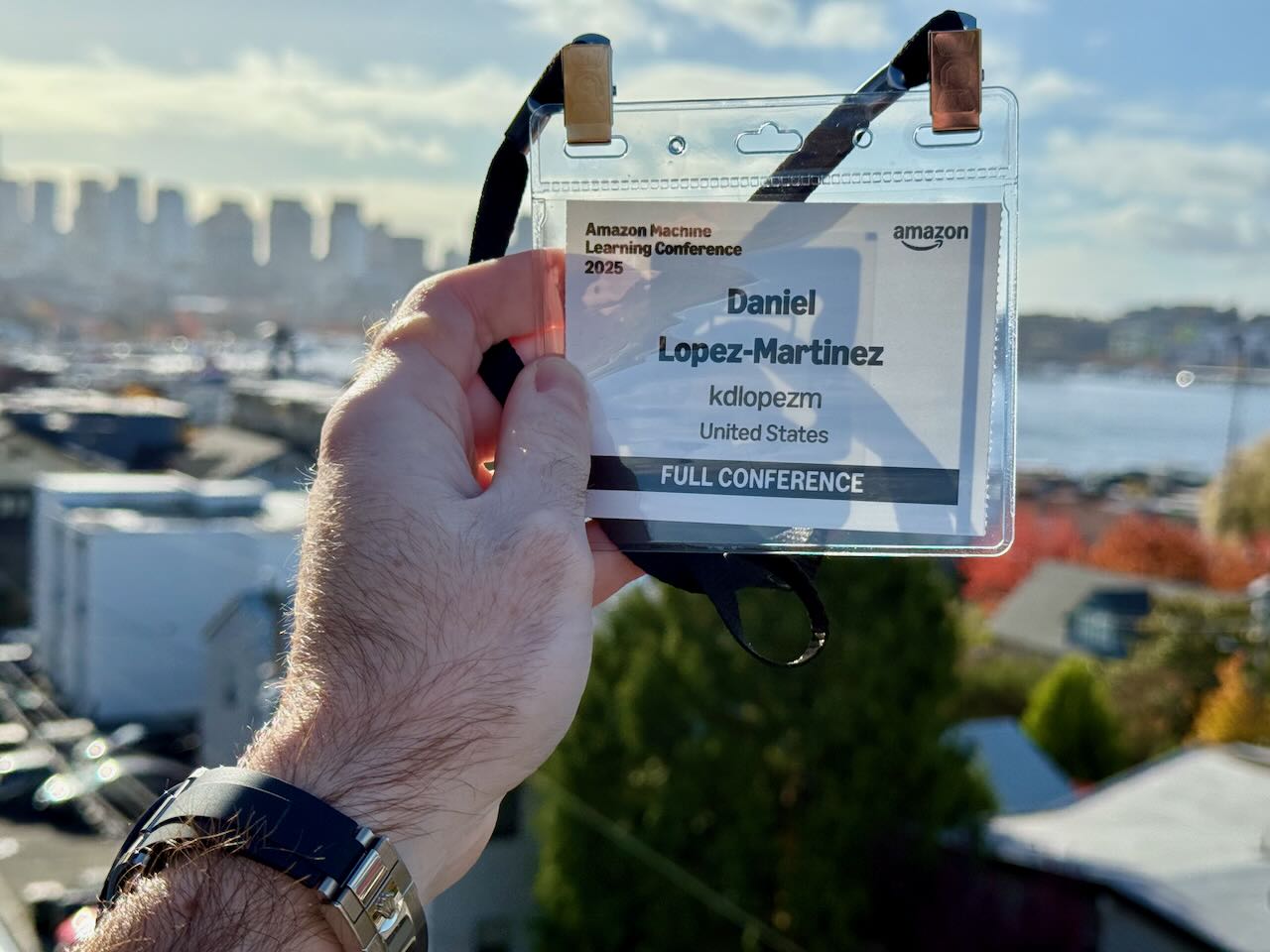
<p><img src="/images/blog/2025-11-07-amlc.jpeg" width="700" height="400" alt="Daniel Lopez-Martinez holding the conference pass with his name for AMLC in Seattle" /></p>

<h2 id="pattie-maes-on-human-flourishing-with-ai">Pattie Maes on human flourishing with AI</h2>

<p>One of my favorite moments at AMLC was seeing <a href="https://www.media.mit.edu/people/pattie/overview/">Pattie Maes</a> give a keynote. Pattie is a professor at the <a href="https://www.media.mit.edu/">MIT Media Lab</a>, where I did my PhD, and she has been thinking about agents and augmentation for decades, long before today’s wave of foundation models. She pioneered the concept of “<a href="http://ieeexplore.ieee.org/document/612209">software agents</a>” in the 90s.</p>

<p>Her keynote traced an arc from early work on robotic and software agents to modern research on contextual, multimodal assistants that help with memory, daily functioning and decision making.  But the core of her talk was a clear challenge of AI: the impact of AI on people is not uniformly beneficial. While always-on, agentic AI promises to improve productivity, current evidence suggests the impact is “mixed at best”. Pattie emphasized the risk of deskilling, where reliance on AI atrophies human capability over time, and pointed to a growing body of studies showing that pervasive AI assistance can influence or weaken fundamental human capacities.</p>

<p>For example, she cited a striking <a href="https://www.thelancet.com/journals/langas/article/PIIS2468-1253(25)00133-5/abstract">Lancet study</a> in which oncologists who used AI assistance for three months improved their diagnostic accuracy during that period. However, when the AI was taken away, they were 20% less effective at identifying cancerous lesions than they had been before the experiment began. In addition to this, she also pointed out AI’s tendency towards sycophancy, prioritizing telling users what they want to hear over the truth, which also homogenizes thought and reduces critical thinking. She also noted that in her group’s <a href="https://arxiv.org/pdf/2506.08872v1">recent work</a>, students using ChatGPT showed significantly less prefrontal cortex activity (the area associated with thinking) compared to those writing essays with standard tools.</p>

<p>This creates a paradox for us as builders: How do we build systems that assist without automating away the user’s agency? To tackle this, Pattie described new initiatives at the MIT Media Lab aimed at building a science of human–AI interaction, such as the <a href="https://www.media.mit.edu/groups/aha/overview/">Advancing Humans with AI (AHA)</a> program.</p>

<p>Among other efforts, the AHA team is working on <a href="https://www.media.mit.edu/events/aha-flourishing-workshop/">benchmarks</a> for the human impact of AI, analogous to today’s technical benchmarks (e.g. for accuracy, latency, etc.), and an “atlas” mapping how design choices influence understanding, critical thinking, social connection and well-being.</p>

<p>Pattie’s keynote was a powerful reminder that as we push toward more capable and autonomous AI systems, we must stay grounded in the question of how they reshape human skills. AI will not only transform workflows; it will transform the people inside them.</p>

<h2 id="chronos-2-the-foundation-model-paradigm-comes-to-time-series-forecasting">Chronos-2: the “foundation model” paradigm comes to time series forecasting</h2>

<p>While LLMs and agents dominated many of the talks, one of the most significant technical unlocks I saw at AMLC was in the domain of time series forecasting, which is often the invisible backbone of logistics, retail, and healthcare.</p>

<p>Amazon’s new model, <a href="https://arxiv.org/abs/2510.15821">Chronos-2</a> (available <a href="https://github.com/amazon-science/chronos-forecasting">chronos-forecasting</a>), moves beyond traditional univariate setups and treats forecasting as a universal, multivariate, zero-shot problem, bringing the foundation model paradigm to time series forecasting.</p>

<p>Chronos-2 is built as an encoder-only transformer with two key ingredients:</p>
<ol>
  <li>Time attention, which captures patterns within an individual series over time.</li>
  <li>Group attention, which lets the model share information across related series in-context.</li>
</ol>

<p>This second feature is what unlocks the “foundation model” behavior: groups of time series and external covariates provide structure the model can leverage without explicit fine-tuning. Instead of retraining or adjusting models for every target, Chronos-2 learns from relationships between series, not just within them.</p>]]></content><author><name>Daniel Lopez-Martinez</name></author><category term="amazon" /><category term="machine-learning" /><category term="ai" /><category term="healthcare" /><category term="llm" /><category term="agentic-ai" /><category term="time-series" /><category term="conference" /><summary type="html"><![CDATA[Attended Amazon's internal Machine Learning Conference (AMLC 2025) and gave a talk on LLM trustworthiness in medical product question answering.]]></summary></entry><entry><title type="html">Launching Buy For Me on the Amazon Shopping App</title><link href="https://daniellopezmartinez.com/posts/2025/04/launching-amazon-buy-for-me" rel="alternate" type="text/html" title="Launching Buy For Me on the Amazon Shopping App" /><published>2025-04-03T00:00:00+00:00</published><updated>2025-04-03T00:00:00+00:00</updated><id>https://daniellopezmartinez.com/posts/2025/04/launching-amazon-buy-for-me</id><content type="html" xml:base="https://daniellopezmartinez.com/posts/2025/04/launching-amazon-buy-for-me"><![CDATA[<p>Today, <a href="https://www.aboutamazon.com/news/retail/amazon-shopping-app-buy-for-me-brands">Buy For Me</a> is launching to US customers on the Amazon Shopping app. This is my first agentic AI system at Amazon, and seeing it go live is a significant milestone.</p>

<p>Buy For Me is a browser-based agentic system that helps customers discover and purchase products from third-party brand websites — even when those items aren’t sold directly by Amazon. The system autonomously navigates real webpages, extracts product information, makes decisions, and completes purchases on behalf of the customer.</p>

<p>Unlike traditional integrations or chat-based assistants, Buy For Me operates directly on dynamic third-party user interfaces using multimodal perception, reasoning, and tool-enabled actions. It delegates complex, multi-step shopping workflows — product discovery, configuration, and checkout — to an autonomous agent acting within the Amazon shopping experience.</p>

<p>This work also led to a <a href="/publication/2025-agentic-ui-automation-patent">patent application</a> on multi-agent computer-use systems for automated interaction with third-party user interfaces.</p>

<p>Read more: <a href="https://www.aboutamazon.com/news/retail/amazon-shopping-app-buy-for-me-brands">Amazon’s Buy for Me</a></p>

<p><img src="/images/blog/buyforme.jpg" width="700" height="400" alt="Amazon Buy For Me agentic shopping system interface showing an AI agent completing a purchase on a third-party brand website." /></p>

<h2 id="media-coverage">Media Coverage</h2>

<ul>
  <li>TechCrunch: <a href="https://techcrunch.com/2025/04/03/amazons-new-ai-agent-will-shop-third-party-stores-for-you/">Amazon’s new AI agent will shop third-party sites for you</a></li>
  <li>Forbes: <a href="https://www.forbes.com/sites/kirimasters/2025/04/08/amazon-buy-for-me-is-the-latest-entrant-in-the-ai-shopping-agent-race/">Amazon ‘Buy For Me’ Is The Latest Entrant In The AI Shopping Agent Race</a></li>
  <li>Engadget: <a href="https://www.engadget.com/ai/amazons-buy-for-me-ai-will-purchase-stuff-from-third-party-websites-123036361.html">Amazon’s ‘Buy for Me’ AI will purchase stuff from third-party websites</a></li>
  <li>The Verge: <a href="https://www.theverge.com/news/642947/amazon-ai-buy-products-other-websites">Amazon can now buy products from other websites for you</a></li>
  <li>9to5Mac: <a href="https://9to5mac.com/2025/04/03/amazons-new-buy-for-me-feature-is-a-wild-ai-innovation/">Amazon’s new ‘Buy for me’ feature is a wild AI innovation</a></li>
</ul>]]></content><author><name>Daniel Lopez-Martinez</name></author><category term="amazon" /><category term="agentic-ai" /><category term="computer-use" /><category term="ai" /><category term="product-launch" /><summary type="html"><![CDATA[Buy For Me, my first agentic AI system at Amazon, is now live for US customers — an AI agent that browses, selects, and purchases products from third-party brand websites on behalf of customers.]]></summary><media:thumbnail xmlns:media="http://search.yahoo.com/mrss/" url="https://daniellopezmartinez.com/images/blog/buyforme.jpg" /><media:content medium="image" url="https://daniellopezmartinez.com/images/blog/buyforme.jpg" xmlns:media="http://search.yahoo.com/mrss/" /></entry><entry><title type="html">PhDone</title><link href="https://daniellopezmartinez.com/posts/2019/10/phd-thesis-defense" rel="alternate" type="text/html" title="PhDone" /><published>2019-10-03T00:00:00+00:00</published><updated>2019-10-03T00:00:00+00:00</updated><id>https://daniellopezmartinez.com/posts/2019/10/phd-thesis-defense</id><content type="html" xml:base="https://daniellopezmartinez.com/posts/2019/10/phd-thesis-defense"><![CDATA[<p>Today I successfully defended my PhD thesis at MIT, completing my doctorate in Medical Engineering and Medical Physics through the <a href="https://hst.mit.edu/">Harvard–MIT Program in Health Sciences and Technology (HST)</a>.</p>

<p>My thesis committee was composed of <a href="https://en.wikipedia.org/wiki/Rosalind_Picard">Rosalind Picard</a>, <a href="https://en.wikipedia.org/wiki/Emery_N._Brown">Emery Brown</a>, and <a href="https://clbb.mgh.harvard.edu/faculty/david-borsook/">David Borsook</a>.</p>

<p><img src="/images/blog/2019-10-03-mit-phd-thesis-defense.jpg" width="700" alt="Daniel Lopez-Martinez with his PhD thesis committee after his defense at MIT: Professor Rosalind Picard, Daniel Lopez-Martinez, Professor Emery Brown, and Professor David Borsook." /></p>]]></content><author><name>Daniel Lopez-Martinez</name></author><category term="mit" /><category term="phd" /><category term="education" /><category term="milestone" /><summary type="html"><![CDATA[Successfully defended my PhD thesis at MIT in the Harvard–MIT Program in Health Sciences and Technology.]]></summary><media:thumbnail xmlns:media="http://search.yahoo.com/mrss/" url="https://daniellopezmartinez.com/images/blog/2019-10-03-mit-phd-thesis-defense.jpg" /><media:content medium="image" url="https://daniellopezmartinez.com/images/blog/2019-10-03-mit-phd-thesis-defense.jpg" xmlns:media="http://search.yahoo.com/mrss/" /></entry><entry><title type="html">Research Featured on MIT News Front Page</title><link href="https://daniellopezmartinez.com/posts/2019/09/mit-news-pain-detection" rel="alternate" type="text/html" title="Research Featured on MIT News Front Page" /><published>2019-09-12T00:00:00+00:00</published><updated>2019-09-12T00:00:00+00:00</updated><id>https://daniellopezmartinez.com/posts/2019/09/mit-news-pain-detection</id><content type="html" xml:base="https://daniellopezmartinez.com/posts/2019/09/mit-news-pain-detection"><![CDATA[<p>My PhD research on using machine learning to detect pain levels from brain signals was featured on the front page of <a href="https://news.mit.edu/2019/detecting-pain-levels-brain-signals-0912">MIT News</a>.</p>

<h3 id="about-the-research">About the Research</h3>

<p>This work addressed a fundamental challenge in medicine: pain is subjective, and clinicians currently have no objective way to measure it. By developing machine learning models that analyse neural signals, we demonstrated that it is possible to detect and quantify pain intensity directly from brain activity — providing a potential pathway toward objective pain assessment.</p>

<p>This is particularly relevant in the context of the opioid crisis, where better pain measurement could help clinicians make more informed decisions about analgesic dosing and reduce the risk of over-prescription.</p>

<p><img src="/images/blog/2019-09-12-brain-fnirs.jpg" width="700" alt="Brain functional near-infrared spectroscopy (fNIRS) signals used for detecting pain levels, from research by Daniel Lopez-Martinez at MIT." /></p>

<p>Read the full article: <a href="https://news.mit.edu/2019/detecting-pain-levels-brain-signals-0912">MIT News — “Detecting pain levels from brain signals”</a></p>]]></content><author><name>Daniel Lopez-Martinez</name></author><category term="research" /><category term="mit" /><category term="healthcare" /><category term="machine-learning" /><category term="neuroscience" /><category term="pain" /><summary type="html"><![CDATA[My PhD research on detecting pain levels from brain signals was featured on the front page of MIT News.]]></summary><media:thumbnail xmlns:media="http://search.yahoo.com/mrss/" url="https://daniellopezmartinez.com/images/blog/2019-09-12-brain-fnirs.jpg" /><media:content medium="image" url="https://daniellopezmartinez.com/images/blog/2019-09-12-brain-fnirs.jpg" xmlns:media="http://search.yahoo.com/mrss/" /></entry><entry><title type="html">Featured in La Razón: Spanish Innovation at the MIT Media Lab</title><link href="https://daniellopezmartinez.com/posts/2019/05/la-razon-mit-feature" rel="alternate" type="text/html" title="Featured in La Razón: Spanish Innovation at the MIT Media Lab" /><published>2019-05-19T00:00:00+00:00</published><updated>2019-05-19T00:00:00+00:00</updated><id>https://daniellopezmartinez.com/posts/2019/05/la-razon-mit-feature</id><content type="html" xml:base="https://daniellopezmartinez.com/posts/2019/05/la-razon-mit-feature"><![CDATA[<p>In May 2019, the Spanish newspaper <a href="https://en.wikipedia.org/wiki/La_Raz%C3%B3n_(Madrid)">La Razón</a> published a double-page feature in its <em>Innovadores</em> supplement profiling me together with other Spanish-speaking researchers at the <a href="https://www.media.mit.edu/">MIT Media Lab</a>. The article, written by journalist <a href="https://estherpaniagua.com/">Esther Paniagua</a>, was the cover story of the supplement and highlighted my work at the <a href="https://www.media.mit.edu/groups/affective-computing/overview/">Affective Computing group</a> together with research across the Lab’s other research groups.</p>

<p>At that time, my work focused on developing AI methods to detect pain through facial expressions, physiological signals from wearables, and brain activity, as well as developing automated methods for opioid administration in clinical settings via reinforcement learning.</p>

<p><img src="/images/blog/2019-05-19-larazon.jpg" width="700" alt="Double-page spread in La Razón's Innovadores supplement featuring Daniel Lopez-Martinez and other Spanish-speaking researchers at the MIT Media Lab, May 2019." /></p>

<p>Read the full print article: <a href="/files/2019-05-19-LaRazon-Reportaje_Hispanohablantes_MIT_Suplemento_Innovadores.pdf">La Razón, Suplemento Innovadores, 19 de mayo de 2019 (PDF)</a></p>]]></content><author><name>Daniel Lopez-Martinez</name></author><category term="media" /><category term="research" /><category term="mit" /><category term="artificial intelligence" /><category term="spain" /><summary type="html"><![CDATA[I was featured in a double-page spread by the national Spanish newspaper La Razón, highlighting leading researchers at the MIT Media Lab.]]></summary><media:thumbnail xmlns:media="http://search.yahoo.com/mrss/" url="https://daniellopezmartinez.com/images/blog/2019-05-19-larazon.jpg" /><media:content medium="image" url="https://daniellopezmartinez.com/images/blog/2019-05-19-larazon.jpg" xmlns:media="http://search.yahoo.com/mrss/" /></entry></feed>